
Mapping the Solution Space for Cross-Agent Tone Consistency From Prompt Templates to Shared Context Layers
Five approaches to keeping AI agents on-brand, ranked by structural depth.
The brand layer for agents is a shared, versioned source of brand identity and rules that connected AI agents use for generation and review. Cross-agent tone consistency spans five approaches, from individual prompt templates to shared infrastructure. The durable solution at scale is not a better prompt, but a system that propagates brand changes without requiring people to update every agent manually.
Why tone consistency breaks down as the number of AI agents grows
One agent sounds professional and punchy, while another sounds friendly and casual. Both may be following their instructions correctly. The inconsistency begins when different team members translate the same human-readable brand guide into separate prompts, leaving each agent to interpret the brand independently. Even with the same source material, agents can read broad descriptions of voice in different ways.
Volume then turns variation into a persistent problem. AI generates work faster than a human review process can inspect it, so inconsistencies reach customers before anyone reconciles them. Without specific constraints, models also tend to sound like generic marketing copy. Each output can look plausible in isolation while the combined work no longer reads as one coherent brand.
The solution spectrum — five approaches ordered by structural depth
Per-agent prompt templates place brand instructions directly inside each agent’s system prompt. Shared prompt libraries give the team one place to find approved snippets, so differences in how people write have less effect. Persistent branded assistants go further by retaining brand guidance inside a configured assistant, so users do not need to supply it with every request. These approaches change where instructions live and who maintains them.
Structured brand context documents make the guidance itself machine-readable, so multiple agents can load the same definition and its constraints instead of getting rules that each person has written in their own way. Shared context layers connect agents to a single versioned brand store, with changes propagating automatically to connected tools. Together, these are five levels of structural commitment. They are not a ranking of output quality, because each can suit a particular operating scale. Greater depth means less dependence on individual discipline as agents, teams, and brands change.
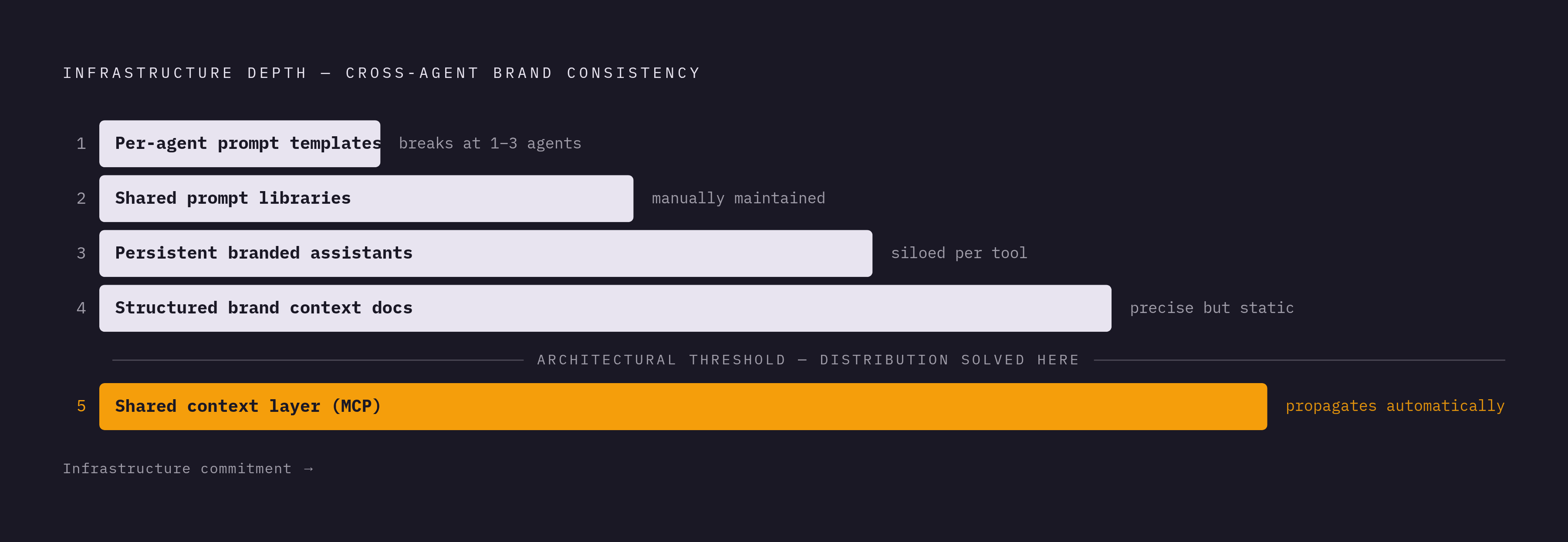
What per-agent prompt templates do well and where they stop working
Per-agent templates are a sound starting point for one person running one agent through one workflow. They are quick to create, easy to tailor to a task, and require no supporting infrastructure. That simplicity has real operational value. A narrowly scoped agent can receive exactly the voice instructions its work requires, without the team first building a broader governance system.
The limit appears when the instructions need maintenance. A brand change requires separate edits to every template, and some copies may remain untouched. Ownership also tends to sit with the person who wrote the prompt, so a handover can lead to reconstruction of the approved rules from memory. In long sessions, context builds up and can pull an agent away from its starting instructions. The practical range is roughly one to three agents, beyond which synchronization work and drift risk begin to outweigh the simplicity benefit.
Shared prompt libraries and persistent branded assistants as the intermediate tier
Shared prompt libraries give teams approved snippets, voice examples, and banned terms, so each person no longer has to work out how to apply a brand guide on their own. The common reference reduces variation at its source. Persistent branded assistants keep the guide in their core instructions, so people no longer have to supply it each time. Custom GPTs in ChatGPT, Gems in Google Gemini, and Projects in Claude provide platform-native ways to keep that context available.
The boundary remains the configured tool or workflow. Someone must update the library or assistant when the brand changes, and that update does not automatically reach every separate agent using an earlier copy. A new integration or third-party tool can therefore fall outside the governance perimeter immediately. Contentstack describes Knowledge Vaults and Voice Profiles as ways to constrain AI output within a CMS.
What a machine-readable brand context document actually contains
A machine-readable brand context document replaces descriptive adjectives with rules an agent can apply. “Bold,” “human,” and “trustworthy” leave operational choices unresolved. Constraints specify sentence length limits, contraction use, second-person versus third-person address, banned terms, required calls to action, and what the audience is assumed to know. The distinction is between naming an impression and defining the behavior that produces it. A rule is specific enough when a new team member or model can follow it without a follow-up question.
Visual identity requires the same precision as language. Instead of “use brand colors,” the context contains specific hex values, gradient rules, minimum logo clear space, and guidance on photography versus illustration. A brand constitution identifies the highest-priority, non-negotiable identity rules, including what the brand never does. A tone ladder then assigns different registers to different stakes, with informal language for brainstorming, professional clarity for customer-facing drafts, and calm precision for legal or financial content. The same decision rules keep the brand consistent while allowing its tone to change with the stakes.
How can multiple AI agents use the same brand identity and guidelines?
A shared context layer separates the brand definition from the agents that use it. The brand lives in one versioned store. Agents connect to that store rather than maintaining independent copies, so an update reaches every connected agent without a person finding and editing each prompt. This solves a propagation problem that more carefully written instructions cannot solve. Manual synchronization works only when someone knows every copy exists and can access it.
Versioning also changes how a team manages revisions. It provides an auditable record of the rules in force at a given time and allows rollback when a change produces poor output. Specialized agents can then share the same definition while performing different jobs, including writing, review, localization guardrails, and compliance checking. Their responsibilities differ, but their governing context does not. Versioned prompts and policies also make it possible to tie outputs to their brand inputs and use observability dashboards to surface drift.
The practical test is a change in policy. When a banned term is added, an approved product name changes, or a tone guideline is adjusted, the context that connected agents use for future drafts should update automatically. That is the architectural distinction between a shared document and a shared service. The service removes the distribution task, although it does not remove the need to check whether generated work follows the rules.
MCP as the protocol that makes a shared brand context connectable across agents
Model Context Protocol gives the brand store a standard interface that compatible agents can query. It connects AI assistants to systems that hold data, including content repositories, brand assets, and business tools. Without a shared protocol, it takes M × N custom integrations to connect M agents to N sources. MCP reduces that integration pattern to M + N, because clients and servers use the same protocol. MCP was donated to the Linux Foundation’s Agentic AI Foundation in December 2025, establishing vendor-neutral stewardship.
Resources expose read-only guidance such as voice rules, approved terms, and visual constraints. Tools provide callable functions such as asset lookups, compliance checks, and brief generation, while prompts help agents use the server for brand-specific tasks. In a multi-agent architecture, a coordinator can delegate through agent-to-agent coordination, or A2A, while specialists retrieve common brand context through MCP. Coordination and brand delivery remain separate functions.
Block, the parent of Square and Cash App, operates over 100 of its own MCP servers internally across a large employee base. That is evidence of the connector pattern being used in an enterprise. Reusable standard connectors let agents reach shared systems without each relationship requiring a custom integration.
Where each approach on the spectrum breaks down in practice
Each approach has a distinct failure condition. Per-agent templates fail at synchronization when a revision reaches some prompts but not others. Shared libraries fail at the perimeter when a new integration operates beyond their reach. Persistent assistants are harder to manage as agencies and multi-brand teams grow because they need to keep a separate assistant for every brand.
Structured context documents solve ambiguity but not distribution. When the brand evolves frequently, even precise documents become difficult to keep current across agents if every copy must be redistributed manually. A protocol-connected layer resolves that propagation failure but introduces an infrastructure dependency. The store must be maintained, versioned, and monitored.
A merger makes these distinctions especially visible. Two companies’ agents may already have drifted from their respective guidelines before their technical systems are combined. Bringing their tones into line needs its own workstream, separate from the work of migration. The decision about which voice applies must be made function by function. Allowing the acquirer’s prompt to survive by default does not resolve the conflicting brand definitions.
What reviewing AI-generated output against brand context adds to the system
Model variation, task complexity, and unanticipated edge cases can still produce output that departs from the supplied rules. Automated brand review checks finished work against the same context that agents used to create it. It grounds review in evidence for specific criteria, including color compliance, voice rules, approved terminology, and visual constraints. This is especially useful at the volume where checking every asset manually becomes impractical.
Adobe Brand Intelligence builds a living, AI-powered brand ontology from guidelines, creative assets, campaign data, and performance results, connecting that intelligence to content creation systems. Xfinity used it to achieve a significant increase in creative output while maintaining brand governance. Human judgment still has a defined role. Sentiment nuance, culturally specific phrasing, and legal or compliance language require review beyond routine automated checks, which handle the volume layer.
When to move from prompts to infrastructure — the decision a team actually faces
The decision turns on operating conditions. A second agent creates a synchronization problem, even if a small deployment can still manage it with templates. When the brand changes often, keeping those templates in line costs more, and even a change once a year means editing every separate copy. Differences also arise when several people write prompts on their own. At scale, people still need machine-readable constraints that everyone uses, even with training.
Agencies and multi-brand operators encounter these pressures together. Each brand needs its own context, and the work of keeping templates for each brand grows as the number of brands is multiplied by the number of agents. The choice depends on how many agents, independent teams, and brands there are, and how often the brand changes. A team with one stable workflow may reasonably retain templates. A team repeatedly reconciling copies has a stronger case for moving the brand definition into shared infrastructure.
For teams making that transition, the practical starting point is to convert the existing guide into machine-readable constraints. That work on the rules helps even before all the connections are in place. The next step is to connect that structured context through a protocol such as MCP, separating the quality of the rules from the mechanism that distributes them. At the infrastructure end of the spectrum, tools connect versioned context to compatible agents such as Claude, ChatGPT, Claude Code, and Cursor, generate briefs from it, and review finished work against it. The defining buying criterion is whether a brand change reaches every connected workflow without another round of manual prompting.