When AI Agents Break Brand Rules Treat It as a Dependency Failure Not a Prompting Problem
Off-brand agent output is a missing input, so fix the source.
Making existing brand guidelines and systems usable by AI agents requires turning them into a structured, shared, versioned resource that agents query at runtime. Off-brand output is a dependency failure when that resource is missing, stale, or unusable. MCP servers and connected knowledge systems give agents access to brand context, and review against that same context checks the work before publication.
Why off-brand AI output is a dependency failure, not a prompting failure
A team rewrites the prompt, the next run looks right, and the following week the output drifts again. The repair worked only for that particular run. Prompts are the visible control surface, so they are the natural place to look when an agent misses the brand’s voice or positioning. But rewriting instructions does not give the agent a source of brand context it can rely on for every task that follows.
The agent attempted to use context it did not have, or had in a form it could not reliably apply. In software engineering terms, that is a dependency failure. A prompting fix patches an output, while a dependency fix changes what every agent can resolve against.
How agentic brand drift actually unfolds — and why it is invisible until it compounds
An agent repeats words that increase response, favors offers that pull demand fastest, and follows the shortest path to a click. Each choice serves the metric being optimized. Across repeated tasks, however, those choices can flatten a distinctive voice, turn pricing into permanent discounting, and displace the slower work of building trust.
The agentic brand drift paper identifies the institutional memory that agents cannot preserve when they cannot access it. That includes pricing concessions during customer hardship, campaigns rejected for conflicting with brand values, and pre-decline outreach that expressed a commitment to transparency. These are not merely examples of approved wording. They explain why the brand makes one choice and turns down another, even when that other choice might look good for business.
For agencies and portfolios, sharing context introduces another failure path when one client’s brand context bleeds into another’s. For founders and solo operators, the erosion can be harder to detect because individual outputs pass casual review. The erosion becomes visible in the accumulated work. When voice erasure and visual incoherence appear together, the audience encounters a brand that no longer presents a coherent identity.
Why the reliability gap in production agents makes brand context a hard requirement, not a nice-to-have
Better task performance does not establish consistency across repeated runs, robustness when conditions change, or predictability about likely failure. A prompt containing brand guidance therefore cannot, by itself, establish dependable brand behavior across a production workflow. The requirement must hold through every generation, including the first response.
UC Berkeley found that system design caused a larger share of multi-agent failures than the limits of the models did. The failures included step repetition, unawareness of termination conditions, and disobedience to task specifications. A missing or stale brand dependency belongs to that same class of design problem. Queen’s University found that nearly every real-world MCP tool examined had at least one significant documentation flaw, leaving agents to infer how the tool worked. Access alone is not enough when the resource remains ambiguous.
Brand drift can consequently remain silent as it accumulates. Multi-step workflows add to the risk because even when each step is reliable, the full chain is less so. Human review may catch some failures, but reading every output becomes a bottleneck at the volume agentic workflows are designed to produce. Review cannot take the place of supplying the missing input.
What existing governance frameworks cover and what they leave out
The EU AI Act, NIST AI RMF, and ISO/IEC 42001 address system behavior and risk, leaving a gap in the meaning coherence that brand consistency requires. Gardhouse, Oueslati, and Kolt’s March 2026 paper, revised July 2026, finds that a regulatory framework designed for conventional AI systems can be structurally ill-suited to agents. The paper looks at challenges that include agents doing tasks on their own, misuse, and unequal access to economic opportunities. Those questions are distinct from whether an output expresses what a particular brand stands for.
The agentic brand drift paper makes that distinction explicit. Governance of behavior does not supply the brand history, positioning, and constraints needed to preserve meaning. An audit log or risk tier cannot answer whether a discount contradicts a brand’s approach to customer relationships. Compliance therefore cannot take the place of the technical work needed to put brand context where the agent can use it during its workflow.
How do you make AI agents use an existing brand system correctly?
The architectural response is to make brand identity a resource the agent queries. A PDF guideline remains useful for people, but it does not itself provide a runtime dependency. Pasting part of it into a prompt supplies a temporary copy. A dependable resource instead has an authoritative source, a version, and an access path for every agent that needs it.
The translation requires design work of its own. “Always use brand colors” leaves a generation model without the proportional constraints needed to apply that instruction consistently. A specification defining the proportion of the primary and secondary colors gives the model an applicable rule. The same difference applies to a broad description of tone and clear, labeled voice guidance that is set up for retrieval. Machine-consumable context must preserve the decision expressed in the guideline.
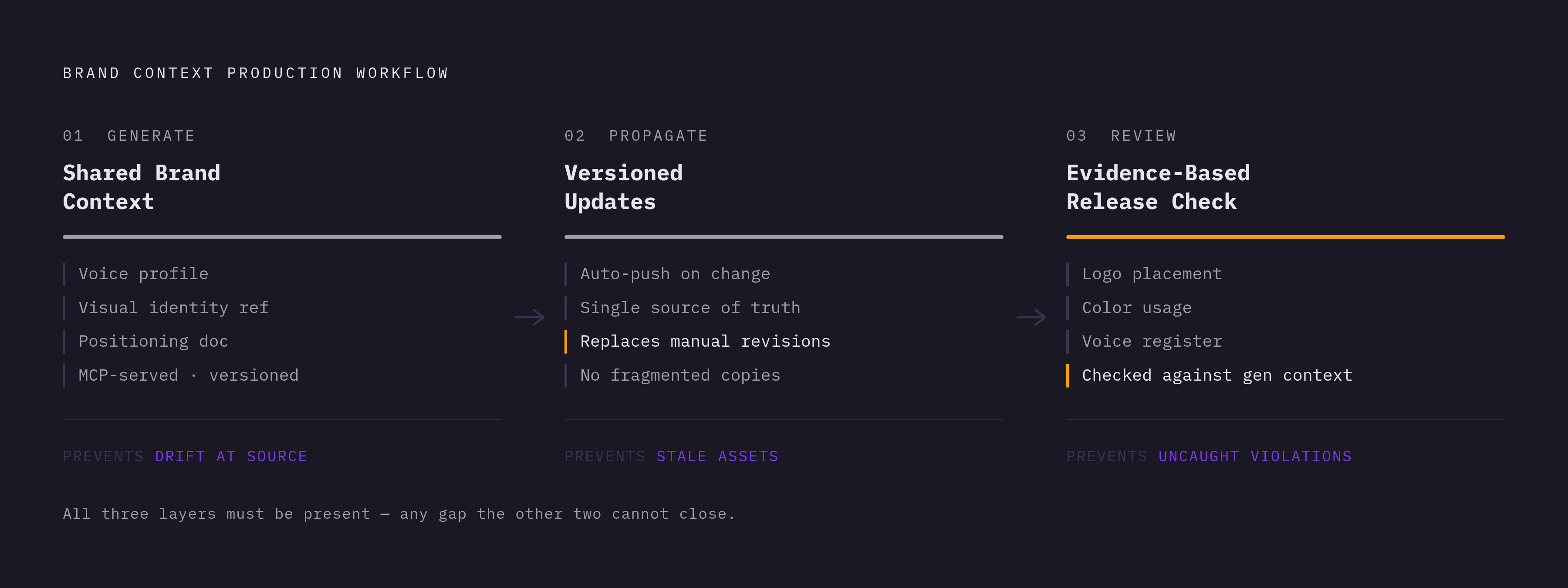
A minimal brand context structure has three components. The voice profile defines how the brand speaks in a form an agent can retrieve. The visual identity reference expresses color, typography, and imagery constraints in a form a generation model can apply. The positioning document explains what the brand is for and what it refuses to be. Together, these components connect expression to intent rather than leaving the agent to imitate surface features.
How MCP makes brand context a shared resource across agents and products
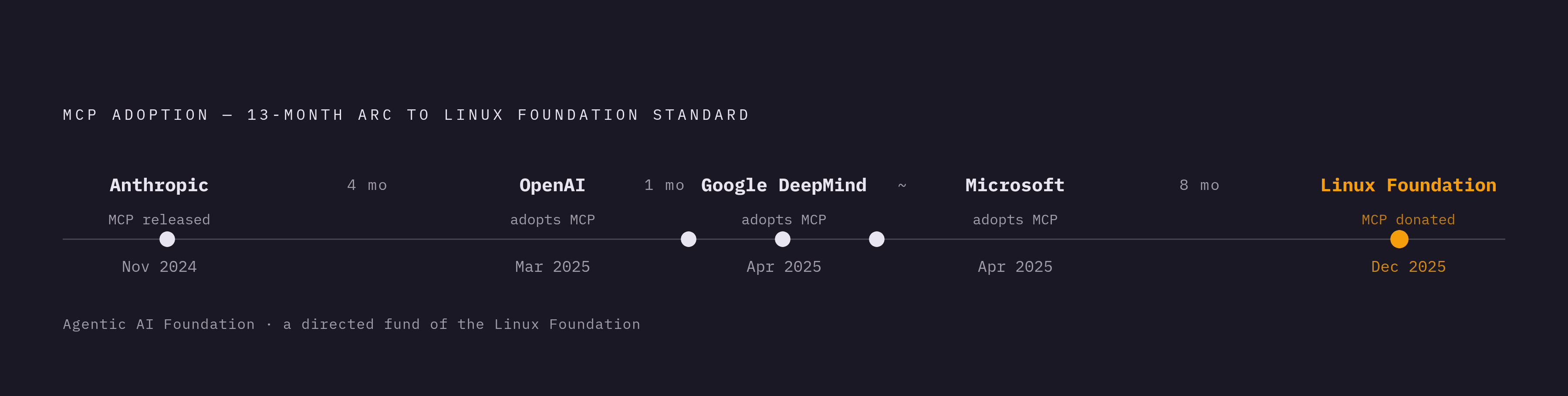
Model Context Protocol gives agents that support it a shared interface they can use to query brand context at runtime. Anthropic released MCP as an open standard in November 2024. OpenAI adopted it in March 2025, followed by Google DeepMind in April 2025, with Microsoft also adopting it. Anthropic donated MCP to the Agentic AI Foundation, a directed fund under the Linux Foundation, in December 2025.
An MCP server can expose voice rules, visual identity, positioning, and specific requirements to tools that need them before generation. Notion and Google Drive MCP servers, for example, let Claude search for and retrieve an ICP document, brand voice profile, and content calendar when those pages or files have been shared with the integration. For visual work, Claude can call Higgsfield MCP to generate images and video clips with the prompt, brand context, and asset in the same thread. The protocol supplies access, while the quality of the context determines what that access enables.
For multi-brand teams, the recommended architecture combines shared infrastructure with separate context for each brand. One platform account can run a separate agent per client, each drawing on its own context. Isolation is part of the design. Agents connecting over MCP and products integrating through a REST API should draw on the same authoritative brand resource to avoid divergent independent copies.
What the Writer vs. Jasper comparison reveals about static versus live brand context
Writer and Jasper show why comparing products calls for looking at how each system is built. Jasper’s knowledge base supports live-synced Google Drive and SharePoint connectors as well as document and URL uploads. Writer’s Knowledge Graph connects to live enterprise data systems so outputs can draw on proprietary data managed within the company. Neither product name alone establishes whether a deployment uses current context. The distinction lies in how the source connects, updates, and becomes available to the agent.
Static files decay between manual updates, while a live connection provides a path to current source material. That path still depends on the source being maintained. The relevant criteria are therefore the authority of the source, its update mechanism, and the agent’s access to it during work. A live knowledge graph and a document upload do not create the same relationship between an output and the underlying brand system.
Old Dominion Freight Line’s Jasper case illustrates the dependency approach in practice. Its challenge was producing timely, strategic, industry-relevant content with a lean team. The company trained a dedicated brand voice through Jasper IQ and supplied industry insights and terminology to the Knowledge Base. Bynder’s brand compliance agents demonstrate the enforcement side by checking logo placement, color palettes, messaging, layout, and channel specifications against multiple rulesets. In both cases, the brand layer operates beyond an individual prompt.
Keeping brand context current as the brand changes — versioning as a system requirement
A shared dependency can still be a stale dependency. Visual refreshes, leadership-driven voice changes, campaign pivots, and market repositioning all change the context connected agents need. If the brand guide changes but the agents’ copies do not, the update has reached only part of the system. The software analogy is precise in that respect, resembling a library patched on one server but not the others.
Old context is not neutral background information. An agent using last quarter’s voice guidelines may reproduce a voice that contradicts the current campaign’s positioning. Versioning shows which state the dependency is in, while propagation makes the change available to connected tools. The practical requirement is for brand context to live and change in one place, with updates propagating automatically to connected agents and products. Manual revisions across separate knowledge bases and prompt templates recreate the original fragmentation.
Adobe Brand Visibility, introduced in June 2026, illustrates a continuous approach to brand context. It combines Semrush’s AI visibility intelligence with Adobe’s agentic content optimization capabilities. The design uses a shared foundation both to track how brands appear across AI-driven discovery surfaces and to generate content based on brand context. Its relevance is the continuous operating model. Brand context is maintained as a live signal rather than treated as a document whose publication completes the work.
Reviewing AI-generated output against brand context before it ships
Shared, current context addresses the input side of generation. Finished work still needs to be checked against that context because an agent can confidently claim success even when it gets the result wrong. The review layer therefore belongs in the workflow before publication. It is not a replacement for the dependency, and the dependency is not a reason to omit review.
The recommended review step tests outputs against the same brand context used for generation, reducing the need for a person to read every asset. Its checks cover logo placement, color usage, voice register, and messaging alignment. Each check needs evidence to support its pass or fail verdict. Voice erasure, visual incoherence, and strategic misalignment can then be tested against clear rules, rather than judged from broad impressions with no link to the source. The review resource must also stay current, or it can approve work against superseded guidance.
For multi-brand teams, review must preserve the same isolation as context delivery. An output that passes for one client has not passed for another. The complete system connects shared context at generation, versioned updates that propagate as the brand changes, and evidence-based review before release. When brand consistency fails, the first diagnostic question is not who wrote the prompt, but whether the dependency is in place.