Keeping Every AI Tool Brand-Consistent Through a Shared Token Layer
A versioned, queryable brand source lets every AI tool follow the same rules.
A shared token layer is the brand layer for agents, a versioned, machine-readable source of colors, typography, voice rules, and logo constraints that connected AI tools query before generating content. With this setup, tools can follow the same rules without people repeating them in prompts, and reviewers can check work against the rules that guided it.
Why per-prompt brand guidance fails at agent scale
When content teams use the same models and tools, their drafts can become interchangeable. Contentoo's State of Content Teams 2026 found that the large majority of content teams use AI regularly and many reach for AI first when output falls short. That response reinforces dependence on broadly shared defaults. The model alone does not distinguish one company. The distinction comes from the information around it, including positioning, approved terminology, brand standards, examples, and the quality signals reviewers apply.
That information rarely lives in one place. A tone-of-voice PDF may sit apart from a messaging document, a brief template, and the knowledge of senior staff. When someone reconstructs that context for a prompt, they create an unofficial edition of the brand. Another team member or agent starts from a different edition, and the differences widen across teams, tools, and content types. Consistency then depends on everyone remembering the same rules and keeping their copies current.
System prompts and fine-tuning on proprietary content do not resolve that distribution problem. A system prompt can encode the language an agent should use, but the copy does not itself propagate a later brand update or serve a certified definition to other agents. Embedding guidance also leaves drift unaudited. The distinction is between a copy and an authority.
What agentic brand drift is and why conventional monitoring misses it
Agentic brand drift happens when agents use different or incomplete brand definitions and their work grows less consistent. It is not necessarily visible as technical failure. Content volumes can rise and response times fall while outputs move away from the brand’s intended position. Conventional dashboards can therefore show improvement without exposing the loss of coherence. By the time brand perception reveals the problem, agents may have generated off-brand work for months.
Vishnyakova’s 2026 paper, Context Engineering: From Prompts to Corporate Multi-Agent Architecture, describes four levels of agent engineering, namely prompt, context, intent, and specification engineering. Each level incorporates the previous one. The paper’s Klarna example illustrates why context alone is insufficient, describing a technically capable agent that optimized for the wrong objective because corporate intent remained implicit. The deficit was not simply missing information. The agent lacked an encoded account of what the organization wanted it to pursue.
That problem becomes harder to diagnose as agents multiply. A hardcoded definition in one agent may cause few obvious problems, while small differences in definitions across many agents can look like unrelated bugs. When agents run on different platforms, local prompt or configuration copies are especially easy to break because they cannot keep the brand’s meaning the same across the whole fleet. More frequent monitoring can expose symptoms, but it cannot make disconnected definitions authoritative. The remedy must be structural because the cause is structural.
What a shared token layer is and what it contains
A shared token layer stores brand rules in a versioned format that machines can query directly. Its visual tokens include colors expressed as hex and RGB values, usage constraints, font families, weight and size scales, line-height rules, spacing, and border radii. Logo rules set the clear space and minimum size and say where the logo may appear. A token used to set a UI component’s button color can also constrain the palette of an AI-generated campaign image.
Verbal identity follows the same principle. Voice tokens set the tone ranges for each channel, which words are approved or prohibited, how long sentences should be, and which compliance constraints apply. Campaign-type rules connect the task, audience, and channel to the appropriate subset of those rules. Rather than interpreting a paragraph about using a bolder launch tone, an agent queries the conditions that define that tone. JSON, APIs, metadata, taxonomy, permissions, relationships, and rule logic make that interpretation concrete.
A guideline document asks a human reader to interpret intent. A token layer gives a machine queryable rules. Vishnyakova identifies five criteria for production-grade context, which are relevance, sufficiency, isolation, economy, and provenance. The layer must give each task enough of the guidance it needs, keep track of where that guidance came from and where it applies, and leave out material unrelated to the task.
Why a centralized layer keeps AI agents on brand without constant manual prompting
Centralization changes how an update reaches the people and tools that need it. When prompts have separate copies of the rules, a palette change means editing those copies across agents and configurations. With a shared, versioned source, the revision becomes one update that connected workflows read. The source changes instead of every local instruction. This removes a recurring dependency on someone remembering where every copy lives.
A common delivery protocol does not provide that authority. MCP’s documentation uses the analogy of a standardized USB-C port for AI applications, which explains how tools connect. But the analogy has a limit. A USB-C cable does not certify that the device at the other end sends the right voltage, and an open protocol does not certify that a brand definition is current or approved. Interoperable endpoints can still deliver contradictory rules.
A governed repository holds the approved definition and its history, so a new campaign palette, revised tone rule, or deprecated logo variant has a traceable place in the system. Platform-locked context must be rebuilt when work moves elsewhere, whereas portable context preserves the definition across delivery channels. Centralization gives generation and drift detection one authoritative standard.
How MCP delivers brand tokens to every connected agent
Model Context Protocol, or MCP, gives AI tools that support it a shared way to get context from outside the tool. For brand teams, an MCP server can expose voice rules, visual tokens, positioning, logo constraints, and specific prohibitions before generation begins. Each tool connects to the source, so it needs no brand copy of its own to keep up to date. Compatibility remains a condition of that access. MCP delivers the governed context. It does not replace its ownership or approval.
Resources are read-only data, such as the approved colors, voice guidelines, rules for where to place logos, and product taxonomy. Tools are callable functions that retrieve a launch campaign’s token set or check a hex value against the approved palette. Prompts provide templated instructions for applying those tokens to a task. These capabilities separate the rules themselves from the operations and instructions that use them.
For example, Claude can call an MCP server to generate on-brand images and video clips with the prompt, context, and asset in the same thread. With these in the same thread, there is no need to rebuild context between sessions or copy it between tabs. Notion and Google Drive MCP servers also allow agents to retrieve voice profiles, ICP documents, and content calendars by name. Google’s Drive MCP server remains in Developer Preview as of late 2026. These connections can bring in an existing knowledge base without letting every document set its own brand rules.
What the token layer governs across AI-generated images, copy, and video
For images, the layer turns identity elements into generation parameters. Approved palettes, fonts, logos, and tone belong in the generation pipeline, together with constraints on logo placement, business name inclusion, and product-specific details. The aim is to preserve the rules that distinguish an approved asset from an attractive but off-brand approximation.
Video also has to keep a subject’s appearance the same as it moves. An Image-to-Video workflow starts with a subject whose appearance is already set, so the model can work out motion without also having to invent how the subject looks. A fine-tuned LoRA approach can also help keep the style the same. The shared layer provides the relevant visual constraints, while the workflow addresses continuity.
For copy, the layer governs approved vocabulary, prohibited terms, sentence-length norms, channel-specific tone, and defined review criteria. First-pass checks can then use explicit rules rather than a senior reviewer’s recollection of the brand’s voice. Humans and agents work from the same foundation. With those shared rules, departments can create work without marketing having to review every piece.
The same structured rules also make review more tractable. Finished images, copy, and video can be checked against the constraints that informed the brief, producing evidence for each brand check. This separates checkable compliance from questions such as whether an idea is interesting or worth publishing, which remain with people.
How multi-brand teams and agencies use a shared layer to manage several brands without fragmenting context
The same architecture extends to several brands without combining their identities. Each brand has a named, versioned package within the shared layer, containing its own audience, marketing goals, tone, visual rules, and constraints. An agent working on client A queries client A’s package. It does not receive an averaged identity. Shared delivery infrastructure and isolated brand definitions are complementary properties of the system.
That isolation becomes more important as clients multiply. Giving each tool a separate brief for each client leaves more places where an old palette or positioning statement can linger. A shared layer keeps the client’s specification intact across those tools, so opening a composer need not trigger another reconstruction of the brand. The task determines which package is relevant.
At design-system scale, a knowledge graph of brand tokens can support agents coordinating token lifecycles, visual rules, and release pipelines across brands, regions, and platforms. Uniform design semantics can coexist with brand-specific customizations. Vishnyakova describes specification engineering as a machine-readable corpus of corporate policies, quality standards, and instructions. For an agency, each client package serves that specification role. Governance needs to be built into the system from the start so that each assignment does not need its own manual setup.
How to build a shared token layer that every connected agent can read
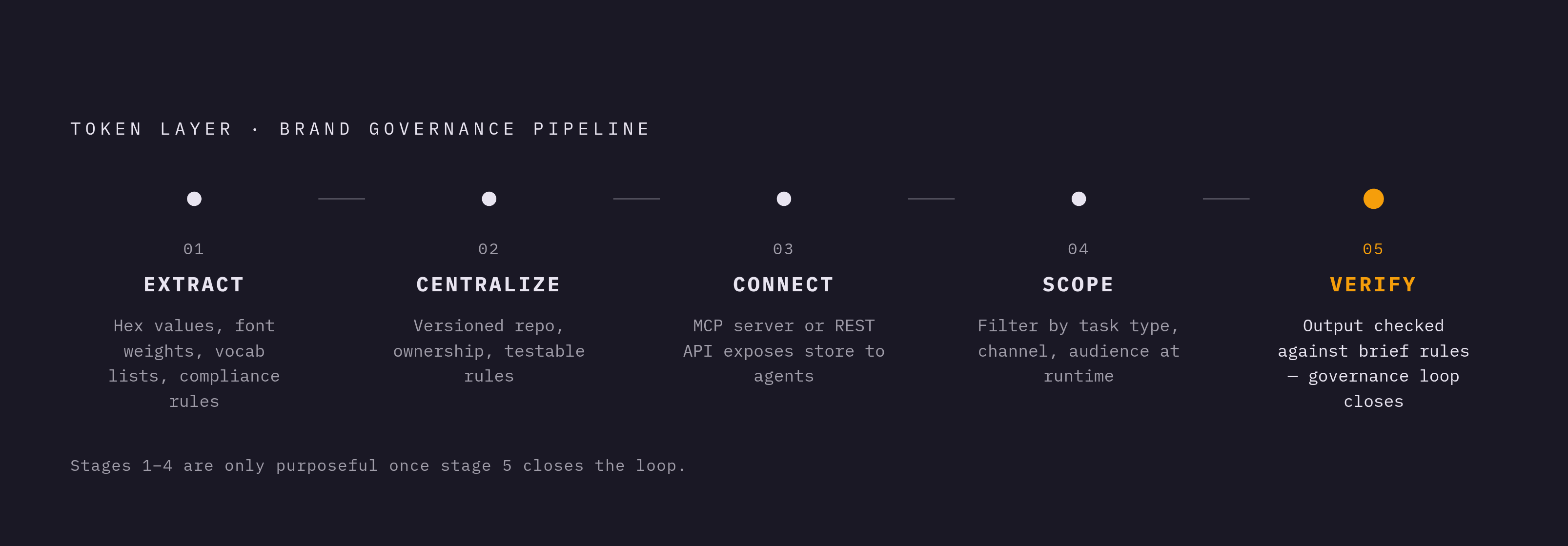
The first step is to extract rules from existing brand assets, including the website, brand guide, logos, fonts, and imagery. Record colors as hex values instead of names, give explicit font-weight scales in place of broad typeface instructions, and name the vocabulary lists to use in place of loose descriptions of tone. Vocabulary, formatting, terminology, tone constraints, and compliance requirements can become queryable fields in JSON or an equivalent structured document. Subjective judgments about what deserves to be said remain outside that document.
Once the rules are explicit, centralize them in a versioned store. The repository needs version history, approved ownership, and testability so that changes are traceable, authorized domain owners control definitions, and drift can be assessed against one source. Versioning makes a changed palette or retired logo an identifiable update. The initial extraction replaces repeated reconstruction, although the brand’s evolving rules still require governed updates.
With an authoritative store in place, connect agents through MCP or an API. An MCP server exposes resources, tools, and prompts, while a REST API can deliver the same context inside a team’s own product. Both channels must get their rules from the same versioned source. At runtime, task type, channel, and audience determine the relevant brief, covering the applicable logo, typography, colors, imagery, and voice rules. The agent receives only the subset it needs.
Finally, review finished work against the rules used to generate the brief. Each check should produce evidence against a defined rule. That closes the governance loop from approved identity through task-specific context to output verification. The layer is then more than a data store.